
Scioto County 72-Hour Release Status
Scioto County has no official 72-hour released-inmate view. The mandatory channel sweep found no rolling selector, release-time field, release-reason field, archive, or three-day endpoint on the sheriff site or its linked vendor roster. The same negative result applies to the 24-hour window. Extending the current display across three checks cannot recreate a verified release log because roster removals may reflect transfer, delayed data, or other custody movement.
The three-day intent is still useful. It gives a clear records-request interval and leaves more room for a court entry or agency status to post. A sheriff booking/release record remains the county source for actual exit. Municipal and Common Pleas dockets explain legal events. ODRC records a transfer into state prison or a state release. VINE can preserve a custody-change notice when registration happened in advance.
Check Scioto County Three-Day Releases
Start by fixing the exact date and local-time boundaries. A vague request for recent releases may not identify a record with enough clarity, while a precise 72-hour range lets the sheriff determine whether an existing log covers it. If no windowed log is kept, shift to named booking records rather than asking staff to create a new compilation.
- Write the exact start and end of the 72-hour interval in local time.
- Check the sheriff-linked current roster only to see who is displayed in custody now. Save the check time.
- Ask the Scioto County Sheriff's Office for any existing release log in that interval, including actual time, code, and destination fields.
- If no log exists, provide full names, dates of birth, approximate booking dates, and InmateIds for individual booking/release records.
- Review Portsmouth Municipal CaseLook and Scioto Common Pleas for the legal event, keeping the Clerk's posting-delay warning in mind.
- Check ODRC or prior VINE notices only when the custody path makes those systems relevant.
The 24-Hour Releases route is better for a tightly bounded same-day check. A 72-hour request is built for the wider period and should not copy a single-day request without changing its endpoints.
Note: Include the year and local time in the request so staff can distinguish the correct three-day span.
Scioto County Three-Day Record Fields
No online 72-hour table supplies these data. They are the existing record fields that make a requested three-day result useful. The release time determines whether an event falls within the interval, while the release code and destination distinguish a community exit from continued custody elsewhere.
| Field to request | Why it matters across 72 hours |
|---|---|
| Name and booking or InmateId | Separates people with similar names and links each exit to a booking. |
| Booking date and time | Shows which custody episode ended during the requested period. |
| Actual release date and time | Places the exit inside or outside the precise three-day window. |
| Release or disposition code | Records bond, court order, time served, transfer, or another maintained reason. |
| Court and charge identifiers | Points to the docket that explains the legal basis. |
| Receiving agency or destination | Shows whether the county exit led to another custodian. |
A booking photo can identify the booking event but does not prove release. Likewise, a court order may authorize release without stating when jail processing ended. The strongest three-day result pairs the sheriff's actual exit record with the related docket or receiving system.
Scioto County Weekend Release Checks
A 72-hour span can bridge days when a one-day search is too narrow. Yet Scioto County publishes no special weekend or holiday release rule, no stated release hour, and no public roster refresh cadence. Do not assume that a court event posts on the same day or that an anticipated weekend date moves to Friday. The research found no current county policy supporting those claims.
The Common Pleas Clerk warns that online posting may lag judicial action by at least 24 hours and sometimes much longer. Municipal and Common Pleas results are therefore corroboration, not a live jail-door clock. Call 740-355-8277 for timely jail information, then request the actual record when the exact release time, reason, or destination matters.
Build the interval around the event being checked. For example, a period that begins before a weekend and ends after it can capture the sheriff records that fall between those endpoints. It cannot prove that the office processed releases on a set schedule. If a court entry appears after the range ends, compare its filing and event dates with the sheriff timestamp. The docket may explain the authority for release even when its online appearance came later. This is why a three-day check is a records comparison, not a promise that all systems update together.
For one known person, the Scioto County released-inmate lookup follows the full custody-specific path rather than trying to assemble a complete three-day list.
Scioto County 72-Hour Fallbacks
The sheriff's public-records policy is the lead route because the online feed is absent. Requests may be made without special wording and generally without giving a reason. Email scso@sciotocountysheriff.com, call the jail, mail the request, or visit 1025 16th Street in Portsmouth. Ask for existing records. The office need not create a new analysis or answer whether someone was really released.
Paper copies cost ten cents per page, while email is free unless an actual production cost applies. The sheriff states a goal of written acknowledgment or possible satisfaction within three business days. That goal does not turn the request into an instant 72-hour feed, but it gives a documented county path when the website cannot answer.
The official request page is shown below as the source for access methods, costs, response practice, and retention schedules.
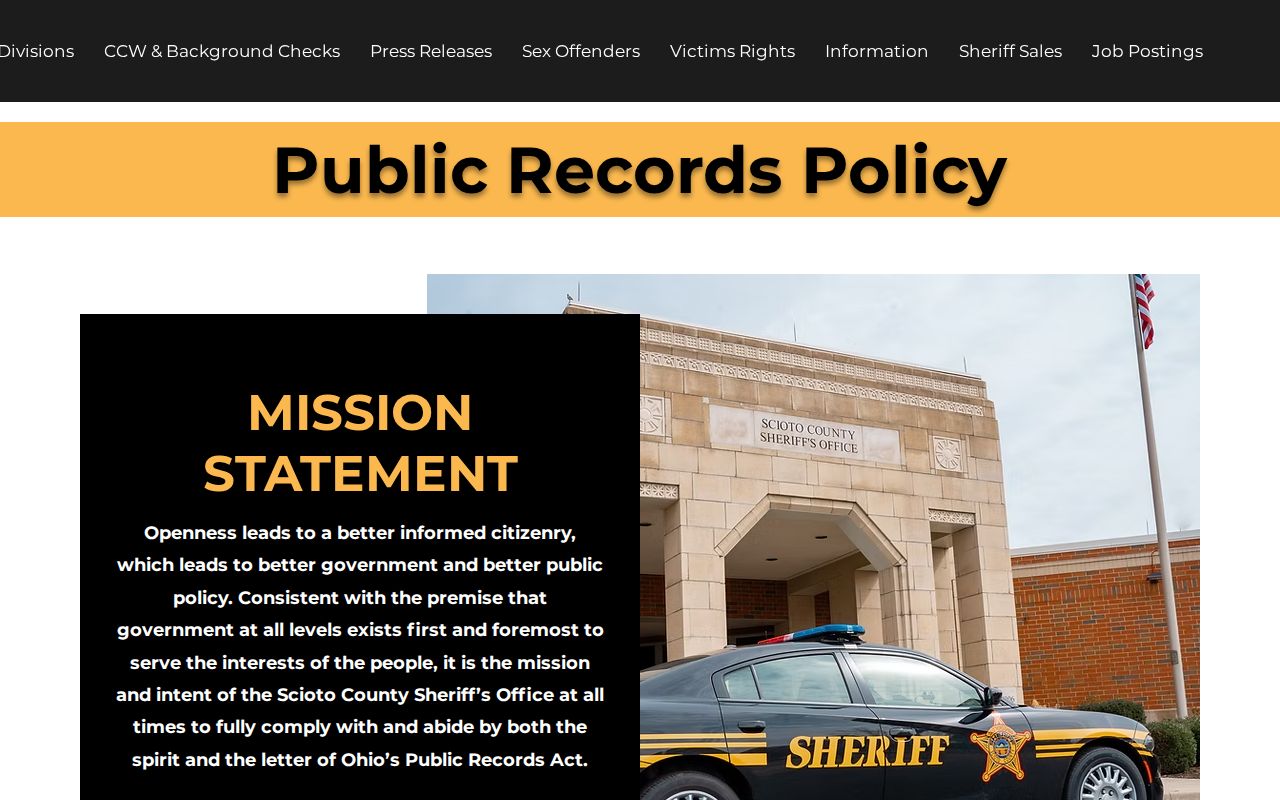
The policy image supports a records-based three-day search rather than suggesting that a hidden online feed exists.
Other systems have narrow roles. Ohio VINE is useful for a person registered before a general release, transfer, escape, or death event. ODRC covers Ohio prison and APA records, not every county-jail booking. BOP and ICE apply only when federal or immigration custody is documented. None substitutes for Scioto's missing county release log.
Note: A phone answer can be quick, but preserve the written record when an exact timestamp or destination must be confirmed.
Scioto County Roster Retention Limits
Scioto's vendor screen identifies itself as a current listing. It shows an inmate photo, surname, first name, middle initial, booking date, physical descriptors, sex, and InmateId, along with search and page controls. It does not display charges, release date, release reason, receiving agency, booking history, or a 72-hour switch. Neither the refresh rate nor the length of post-release visibility is published.
Underlying records and public-screen visibility are separate issues. The sheriff says records follow approved retention schedules available at the office. That does not mean the web interface keeps a departed person's row for a fixed number of days. A missing row simply starts the verification process.
The officially linked current roster pictured here has no three-day release control.
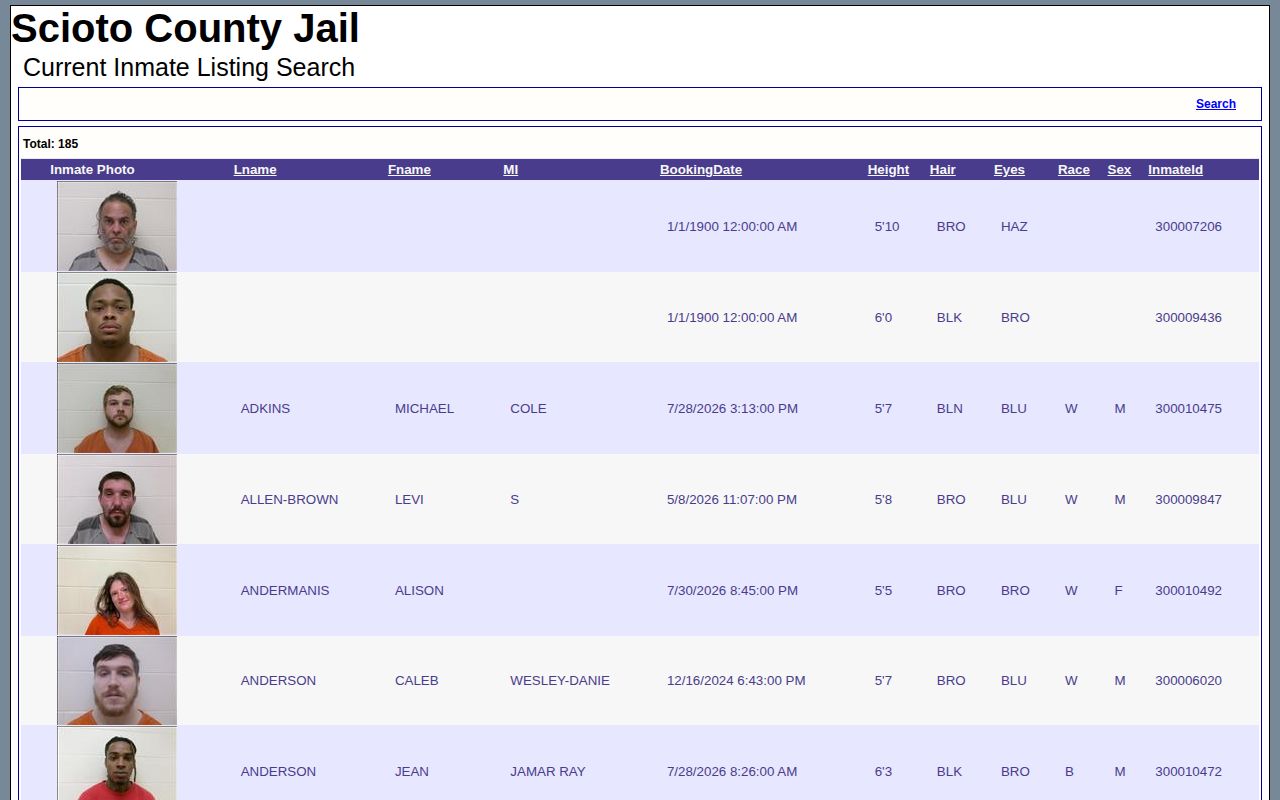
The visible current-custody fields help identify a booking, while the omitted exit fields must come from the sheriff record.
Scioto County Release Systems
Three local correctional layers make a three-day check easy to misread. Scioto County Jail is the county facility. Southern Ohio Correctional Facility is an ODRC state prison whose residents can come from anywhere in Ohio. STAR Community Justice Center is a regional community-based correctional facility tied to courts and community control. One public roster cannot cover all three.
- County-jail release
- Confirm with the sheriff booking/release record and the matching Municipal or Common Pleas docket.
- State-prison release
- Use ODRC Released or APA Supervision status and read the release detail. A prison transfer remains incarceration.
- STAR exit
- Confirm with STAR, the committing court, and probation or community control. Leaving residence may not end supervision.
- Transfer
- A move to another custodian ends one placement but is not release to the community.
Ohio VINE can support both county-jail and state-prison event notice, but its event set depends on the custodian. A transfer notice must never be reported as a community release. The originating record supplies the durable explanation.